
CHEXX and Singapore Online Gambling Law: What the GRA Rules Say
Singapore’s Gambling Regulatory Authority (GRA) states that it is an offence for a person in Singapore to participate in unlicensed remote gambling activities. GRA also states that Singapore Pools is the only operator it licenses to provide remote gambling services. CHEXX does not have a verified Singapore GRA remote-gambling licence. Available source material separately records that CHEXX operationally accepts Singapore users and that the operator holds a Curaçao licence. Those points do not amount to Singapore authorization.
The practical takeaway is to keep three questions separate: whether CHEXX technically accepts an account, whether CHEXX holds an offshore gambling licence, and whether Singapore law authorizes the remote gambling service locally. For a Singapore reader, the third question is decisive for local legal context. This page explains that framework without suggesting VPNs, payment workarounds or any other method of bypassing controls.
The full picture is in our CHEXX review for Singapore.
The core Singapore rule
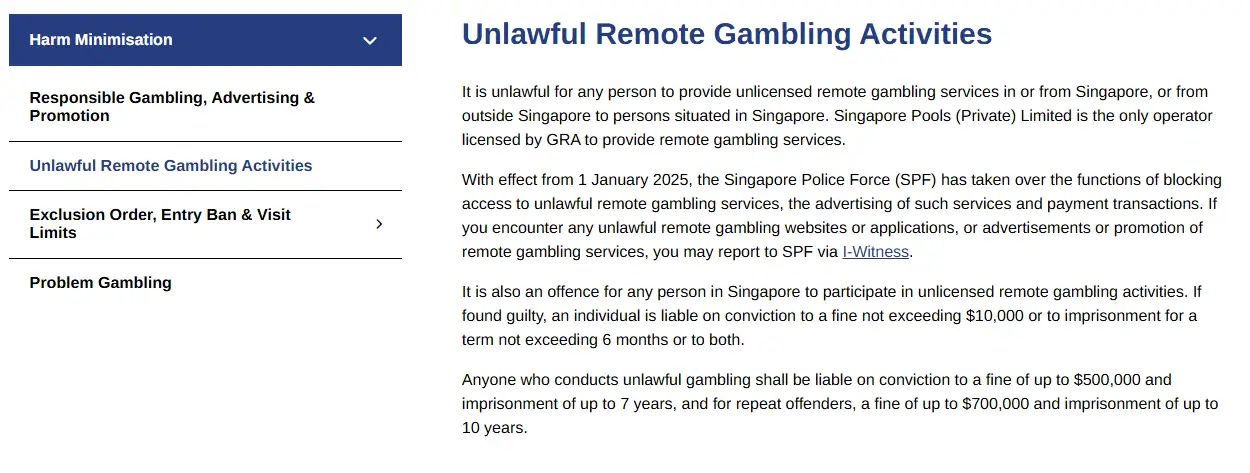
The current GRA guidance is unusually direct. It says unlicensed remote gambling services cannot lawfully be provided in or from Singapore, or from outside Singapore to people situated in Singapore. It also states that participation by a person in Singapore in unlicensed remote gambling is an offence. GRA identifies Singapore Pools (Private) Limited as the only operator licensed by GRA to provide remote gambling services.
That wording is more useful than broad phrases such as “online gambling is regulated” because it addresses both sides of the remote service: the provider and the participant. It also gives a clear local licensing benchmark. If an operator is not the GRA-licensed remote operator identified by the regulator, a foreign licence should not be described as equivalent Singapore approval.
How the Gambling Control Act 2022 fits in
The Gambling Control Act 2022 is the core Singapore statute for gambling outside casinos, including remote gambling. Singapore Statutes Online shows the Act as current and defines remote gambling around gambling conducted using remote communication. The definition is broad enough to cover internet-based services even where only part of the activity happens through remote communication.
The Act also distinguishes Singapore-customer links and addresses services that may be provided outside Singapore but are accessible to people physically present in Singapore. That matters for offshore websites: the location of the operator does not, by itself, remove the Singapore legal context for a participant situated in Singapore.
This is general editorial information, not personal legal advice. The important sourced point is narrower: GRA’s present public guidance expressly classifies participation in unlicensed remote gambling in Singapore as an offence.
CHEXX acceptance is not the same as Singapore authorization
| Question | What the evidence says |
|---|---|
| Does CHEXX operationally accept Singapore? | The documented CHEXX information records Singapore as accepted and not among CHEXX’s seven restricted GEOs. |
| Does CHEXX have an offshore licence? | Yes. CHEXX has a verified Curaçao Gaming Authority licence, OGL/2024/1332/0669. |
| Does CHEXX have a verified Singapore GRA remote-gambling licence? | No. GRA says Singapore Pools is the only operator it licenses for remote gambling services. |
This distinction prevents two common errors. A site being technically accessible or allowing registration does not establish that local law authorizes participation. Conversely, the lack of a Singapore licence does not mean independently verified product facts about the website vanish. It means those product facts must not be presented as proof of local permission.
For operator and offshore-regulator details, see the separate CHEXX licence. This page stays focused on Singapore law rather than repeating the full Curaçao certificate analysis.
Why the Curaçao licence does not answer the Singapore question
CHEXX’s Curaçao licence is relevant to operator identity and offshore regulatory status. It is not a passport that automatically creates authorization in every jurisdiction where the website can be reached. Singapore has its own regulator and statutory framework. A correct description therefore says CHEXX is licensed in Curaçao while no Singapore GRA remote-gambling licence is verified.
That wording also avoids the opposite overstatement. This page does not claim that the Curaçao licence is fake or irrelevant. It is a real regulatory fact. The point is that licence scope matters: Curaçao authorization and Singapore authorization are different legal questions.
Blocking, advertising and payment enforcement
GRA’s current guidance notes that, from 1 January 2025, the Singapore Police Force took over functions involving blocking access to unlawful remote gambling services, advertising of such services and payment transactions. The Gambling Control Act framework also regulates unlawful gambling advertising and inducements.

These powers are useful context because Singapore’s approach is not limited to licensing paperwork. Enforcement can address access, promotion and transaction channels. This site does not provide instructions for evading such measures. A reader encountering a blocked service should treat the block as an enforcement signal, not as a technical obstacle to be routed around.
What about gambling winnings tax in Singapore?
IRAS states that winnings from betting, lotteries and casino gambling in Singapore are generally treated as windfalls rather than income and are not taxable. IRAS says such winnings do not need to be declared in an individual income tax return. That is the appropriate narrow tax statement for this page.
It should not be stretched into a universal claim that every possible offshore or crypto-related receipt is tax-free in every circumstance. The IRAS page describes the treatment of winnings in Singapore. It does not, on the material checked for this page, provide a bespoke ruling for every offshore account structure, token conversion or separate trading activity. Where a transaction has features beyond a straightforward gambling win, a reader should distinguish the gambling win from any other potentially relevant activity.
What Singapore readers should verify before relying on a casino review
A useful review should keep legal status separate from product convenience. Check whether the operator has a local licence, what the local regulator says about participation, and whether any claimed protection actually follows from that licence. Then assess the product on separate evidence: payment rails, withdrawal procedure, games, support and account verification.
For CHEXX specifically, do not infer Singapore approval from English-language access, operational account acceptance, crypto deposits or a Curaçao licence. None of those facts changes GRA’s statement about unlicensed remote gambling. Likewise, do not infer that a foreign licence provides GRA complaint handling or Singapore-specific consumer protection.
If your interest is practical cashier mechanics rather than law, the CHEXX payments covers the documented crypto setup. Keeping that material separate avoids turning payment availability into a misleading legal signal.
How this applies to CHEXX sportsbook use
The same Singapore remote-gambling framework applies to the betting side of CHEXX. Sports and esports markets are product categories, not a separate exemption from the GRA position described above. The CHEXX sportsbook therefore discusses market structure and esports coverage without suggesting that product availability creates local authorization.
This is particularly important for esports because a visible commercial partnership or tournament sponsorship can look like institutional approval. A partnership can verify that two companies are working together. It does not establish a Singapore gambling licence for the betting operator.
Bottom line
- GRA says participation in unlicensed remote gambling by a person in Singapore is an offence.
- Singapore Pools is the only operator GRA identifies as licensed to provide remote gambling services.
- CHEXX has no verified Singapore GRA remote-gambling licence.
- CHEXX’s verified Curaçao licence and operational acceptance of Singapore users are separate facts and do not create Singapore authorization.
- From 1 January 2025, SPF took over blocking functions covering unlawful remote gambling access, advertising and payment transactions.
- IRAS says betting, lottery and casino winnings in Singapore are generally windfalls and not taxable as income, but that statement should not be overextended to every offshore or crypto scenario.
The strongest way to read CHEXX in Singapore is therefore not “available equals legal” or “foreign licence equals local licence”. Treat operational access, offshore regulation and Singapore authorization as three different layers, and use the GRA rule as the governing local context.
Three separate questions should not be collapsed
The archive distinguishes operational acceptance, foreign licensing and Singapore authorization because they answer different questions. CHEXX can record Singapore as operationally accepted while still lacking a verified GRA remote-gambling licence. Its Curaçao licence identifies an overseas regulatory basis for the operator, but that licence does not replace Singapore authorization for services offered to people in Singapore.
The Singapore-specific rule therefore remains the controlling local context for a Singapore reader: GRA states that participation in unlicensed remote gambling is an offence and identifies Singapore Pools as the only GRA-licensed remote-gambling operator. This is why site accessibility, account creation or a foreign licence should not be used as shortcuts for deciding local legal status.
Why payment and access blocking are context, not workarounds
Singapore enforcement can include blocking measures, but that does not create a basis for circumvention advice. The relevant editorial point is simply that technical accessibility can change independently of CHEXX’s own country-acceptance model. This archive therefore does not recommend VPNs, alternative routing or payment workarounds.
The licence the operator actually holds: the Curaçao details.
 Sugar LandFelix Gaming
 Wild FudgeBetixon
 Romance VFugaso
 Sevens HighRoyal Slot Gaming (RSG)
 CleopatraIGT
 Maneki FortunesSkywind Group
 Hot Hot BalloonsArmadillo Studios
 Book of the SunPascal Gaming
 Sugar RushPragmatic Play
 Sweet FTNGameArt
 Beef Up the Bonus Power ComboHigh Limit Studio
 Lollipop Drop MultiMaxBulletproof Games
 GemonexBetixon
 Sizzling Hot DeluxeNovomatic
 Vegas Strip BlackjackClassic
 Single Deck Blackjack GoldSingle Deck
 VIP American BlackjackVIP
 Blackjack Surrender OriginsSurrender
 Multihand BlackjackMultihand
 European BlackjackMultihand
 Turbo BlackjackFast-play
 Blackjack Lucky LadiesSide Bet
 Ultimate Blackjack with RachaelLive-style
 Atlantic City BlackjackClassic
 Quantum Blackjack PlusMultiplier
 Blackjack 21 ClassicClassic
 Vegas Downtown Blackjack GoldGold Series
 Classic BlackjackClassic
 Perfect Pairs BlackjackSide Bet
 American RouletteClassic
 Roca Riches RouletteThemed
 Mega Fire Blaze RouletteMultiplier
 Auto RouletteSwitch Studios
 Gold RouletteGold Series
 Lucky RouletteClassic
 Immortal Romance RouletteThemed
 Mini Roulette 3DMini
 Multifire RouletteMultiplier
 Monopoly Roulette TycoonThemed
 Who Wants to Be a Millionaire RouletteThemed
 Quantum RouletteMultiplier
 French RouletteNetEnt
 RouletteRelax Gaming
Published by the Chexx Casino team.